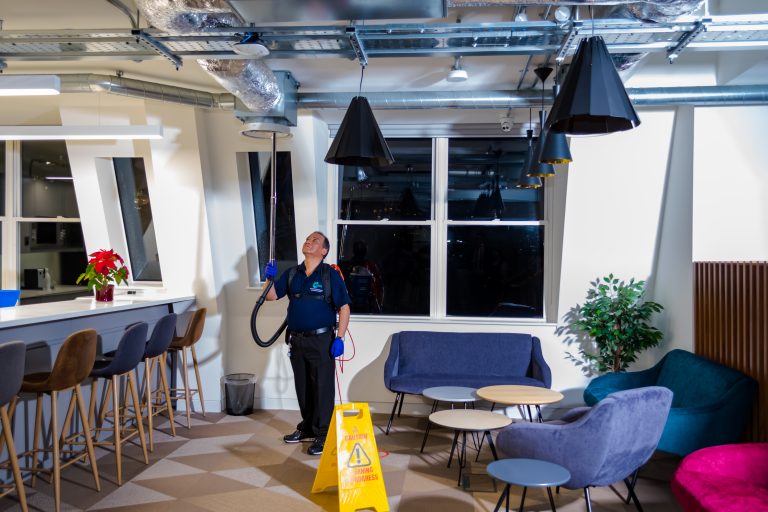
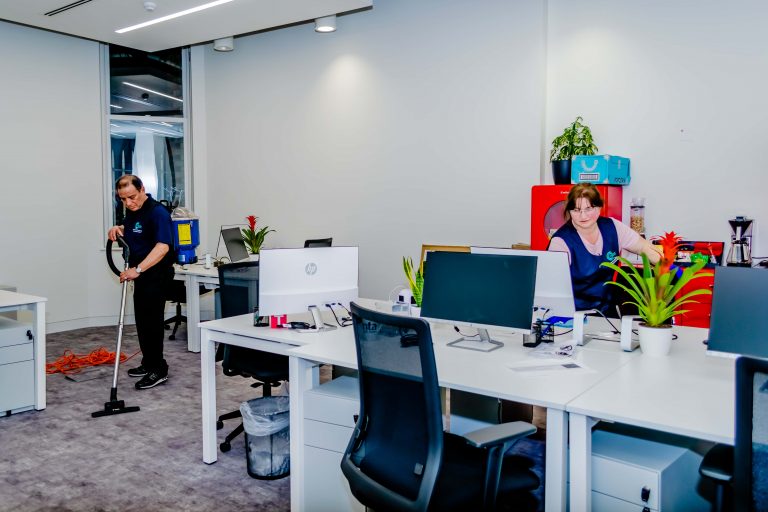
Yes, commercial cleaning can be genuinely eco-friendly, but the term covers a wide range of approaches. Green cleaning combines biodegradable products, reduced chemical use, efficient equipment, and waste management to lower your building’s environmental footprint.
For UK businesses with ESG commitments or sustainability reporting obligations, choosing a contractor with verifiable environmental credentials matters. This guide explains what sustainable commercial cleaning looks like in practice, and what to look for when evaluating providers.
“Eco-friendly cleaning” appears in almost every commercial cleaning company’s marketing. The phrase gets applied to everything from a single biodegradable product to a fully documented environmental management programme, and the gap between those two things is considerable.
For facilities managers and procurement leads with ESG targets or sustainability reporting obligations, that vagueness creates a real challenge.
If you’re selecting a contractor partly on environmental grounds, you need to know what you’re actually getting, and how to tell the difference between a genuine commitment and surface-level messaging.
This article breaks down what sustainable commercial cleaning really means: the products, the practices, the certifications, and the regulatory context.
By the end, you’ll know exactly what questions to ask, what credentials carry weight, and how a well-run green cleaning programme delivers real operational and reputational value alongside its environmental benefits.
What Does Eco-Friendly Commercial Cleaning Actually Mean?
When a contractor describes themselves as eco-friendly, it’s worth asking which part of their operation that actually applies to.
Product choice is the most visible element, but equipment efficiency and consumable waste management are equally significant.
A genuinely sustainable cleaning programme addresses all three.
Products and Chemistry
The foundation of any green cleaning approach is product selection.
Eco-friendly cleaning products are formulated to be biodegradable, free from phosphates and chlorine-based compounds, and designed to minimise harm to aquatic ecosystems when they enter drainage systems.
Many carry third-party accreditations: the EU Ecolabel, for example, sets strict criteria for environmental performance and human health impact.
That said, “natural” and “non-toxic” are not regulated terms in the UK.
You can label a product either way without independent verification. This is why accredited product ranges matter.
Checking that a contractor uses products with documented biodegradability data and independent certification gives you something concrete to assess, rather than a marketing claim to take on faith.
Equipment and Methods
Beyond chemistry, the equipment your contractor uses and how they use it has a direct bearing on environmental impact.
Microfibre cloths and mops are a straightforward example of technology that genuinely reduces chemical dependency. Used correctly, they clean effectively with water alone or with minimal product, cutting both chemical consumption and the volume of residue entering drainage systems.
Research indicates that microfibre mopping systems can reduce chemical usage by up to 90% compared with conventional cotton mop systems.
Water-efficient cleaning methods, high-efficiency vacuum systems with HEPA filtration, and battery-powered or low-emission machinery all reduce your building’s overall environmental load.
These aren’t fringe innovations; they’re now standard in contractors who take environmental performance seriously.
Waste and Consumables
The management of consumables is an area that often gets overlooked. Over-ordering stock, storing products incorrectly, or making emergency purchases outside a contractor’s normal supply chain can all undermine an otherwise sound environmental policy.
Proper stock control, including real-time tracking, accurate usage records, and managed reordering, prevents waste at the source and ensures that environmental product choices don’t get bypassed when supplies run low.
What UK Regulations Apply to Commercial Cleaning?
Understanding the compliance framework helps you evaluate whether a contractor is genuinely meeting their obligations or simply describing their intentions.
COSHH and Green Products
The Control of Substances Hazardous to Health Regulations 2002 (COSHH) apply to all substances used in the workplace, including those labelled natural or non-toxic.
Even plant-based cleaning products can contain allergens, irritants, or concentrated acids that require formal risk assessment. This applies regardless of how a product is marketed.
A contractor who takes both environmental and safety compliance seriously will maintain full COSHH assessments for every product in their range, including eco-formulated ones.
If a provider tells you their products are “safe” without being able to produce the relevant documentation, that’s a gap worth probing.
ISO 14001 Environmental Management
ISO 14001 is the international standard for environmental management systems.
Achieving certification means a contractor has established a documented framework for identifying and reducing their environmental impact, and that framework is independently audited on an ongoing basis.
This is meaningfully different from a self-declaration (any company can state that it cares about the environment).
ISO 14001 certification requires evidence of policies, targets, monitoring, and continual improvement, verified by an accredited body.
For organisations asking their supply chain to demonstrate environmental credentials, it’s one of the most reliable benchmarks available.
ESG Reporting and Procurement
Sustainability expectations in procurement have grown considerably
According to Make UK’s 2024 ESG in Manufacturing Report, 74% of UK firms have now incorporated ESG conditions into their procurement strategies, up from 66% two years prior, and 77% receive ESG requirements from their own customers.
Facilities management sits firmly within that scope.
A cleaning contractor with documented environmental management, verified product data, and measurable waste reduction practices gives you meaningful data to feed into your own reporting obligations, rather than anecdotal assurances that are difficult to quantify or evidence.
Sustainable Office Cleaning
What Does Sustainable Commercial Cleaning Look Like in Practice?
Understanding the principles is one thing; seeing how they translate into day-to-day operations is another.
Here’s what a well-run sustainable cleaning programme actually looks like on the ground.
Biodegradable and Accredited Products
The most straightforward indicator is whether a contractor uses products from an accredited eco range with verifiable environmental data.
This means products formulated to comply with biodegradability standards and backed by technical safety data sheets, not just a green label on the bottle.
Alliance Cleaning has used the Jangro Enviro/ntrl chemical range for over twenty years.
These products comply with European regulations on biodegradability and environmental preservation, with manufacturer-provided impact data available for review.
Microfibre and Water-Efficient Equipment
Microfibre technology has transformed what’s possible in low-chemical cleaning. The fibres work by physically lifting and trapping particles rather than relying on chemical action, which means many surfaces can be cleaned effectively without detergent.
For high-contact areas and general maintenance cleaning, this significantly reduces the volume of product used across a site.
Water-efficient mopping systems, which use measured amounts rather than open buckets, reduce both water consumption and the risk of over-wetting floors.
This has knock-on benefits for indoor air quality and surface longevity.
Stock Control and Waste Reduction
Effective consumable management is a practical environmental measure that good contractors take seriously.
This means maintaining accurate records of product usage per site, tracking stock levels in real time, and ensuring reordering follows the approved supply chain. When stock is managed well, you avoid both the waste of over-ordering and the environmental risk of emergency purchases that may not meet the same product standards.
Why Does Staff Training Matter for Eco-Friendly Commercial Cleaning?
Even the best products and equipment achieve little without staff who know how to use them correctly.
Dilution rates really matter: a product used at twice the recommended concentration doesn’t clean better. It wastes product, increases chemical load, and can damage surfaces.
Selecting the right product for the right surface type, following correct application methods, and maintaining equipment properly are all skills that need to be actively taught and regularly refreshed.
This is where a contractor’s approach to staff development becomes environmentally relevant.
Alliance Cleaning’s Alliance Pathway training programme covers product knowledge, correct usage, and waste minimisation as core components, not as optional additions. When cleaning operatives understand why these practices matter, they apply them consistently rather than cutting corners under time pressure.
ISO 45001 certification for health and safety management reinforces this: a contractor who demonstrates commitment to their staff’s welfare through formal training and documented procedures is applying the same discipline to environmental compliance.

How Do You Evaluate a Cleaning Contractor’s Environmental Credentials?
If you’re assessing a commercial cleaning contractor on environmental grounds, knowing what to ask makes the process considerably more productive than relying on their marketing materials alone.
Certifications to Look For
ISO 14001 is the most meaningful independent certification for environmental management.
It demonstrates that a documented system exists, that it’s regularly audited, and that the contractor is actively working to reduce their environmental impact over time. BICSc (British Institute of Cleaning Science) membership indicates professional standards across operations more broadly.
Product accreditations are also worth checking.
Ask whether the products used carry recognised third-party accreditation (such as EU Ecolabel certification obtained via an EU member state body, or compliance with the UK Government Buying Standards for cleaning products) and request access to technical data sheets that confirm biodegradability and environmental safety ratings.
Questions Worth Asking
Beyond certifications, a few direct questions will tell you a great deal.
Ask how the contractor manages stock and consumables on site, and whether they can provide usage data. Ask whether their COSHH assessments cover eco-formulated products specifically, not just conventional chemicals.
Ask what their staff training programme covers in relation to product use and waste reduction. And ask whether they can provide environmental performance data that you could use in your own ESG reporting.
A contractor who can answer these questions with documentation distinguishes genuine environmental commitment from a well-worded policy statement.
Conclusion
Sustainable commercial cleaning is achievable, verifiable, and increasingly expected, both by organisations managing their own ESG commitments and by the clients and stakeholders they report to.
It isn’t one thing: it’s a combination of accredited product choices, appropriate equipment, documented waste management, trained staff, and independently verified environmental management systems working together.
For any business selecting a cleaning contractor, the ability to demonstrate environmental credentials through certification and operational data matters.
Alliance Cleaning holds ISO 14001, ISO 9001, and ISO 45001 certifications and has maintained a consistent approach to eco-friendly product use and staff training for over twenty-five years.
To discuss how that translates to your specific site requirements, call 01992 700073 or email [email protected].
Frequently Asked Questions
What is eco-friendly commercial cleaning?
Eco-friendly commercial cleaning refers to cleaning programmes that use biodegradable, accredited products, water-efficient methods, and waste reduction practices to lower environmental impact. It covers product chemistry, equipment selection, consumable management, and staff training, not just the choice of a single “green” product. Genuine programmes are underpinned by ISO 14001 environmental management certification.
Do COSHH regulations apply to eco-friendly cleaning products?
Yes. The Control of Substances Hazardous to Health Regulations 2002 apply to all substances used in the workplace, including those labelled natural or non-toxic. Even plant-based cleaning products can contain irritants or allergens that require formal risk assessment. Any reputable contractor should maintain COSHH documentation for every product in their range, regardless of its environmental credentials.
What does ISO 14001 certification mean for a cleaning company?
ISO 14001 requires a company to establish, maintain, and continually improve a documented environmental management system, independently audited on an ongoing basis. For a cleaning contractor, this means having measurable environmental targets, policies covering product selection and waste management, and evidence of performance reviewed by an accredited body, rather than a self-declared commitment to sustainability.
Are green cleaning products as effective as conventional ones?
Yes, when used correctly. Modern eco-formulated products are designed to meet the same performance standards as conventional alternatives while reducing environmental impact. Microfibre equipment enhances the effectiveness of low-chemical methods by physically removing particles rather than relying on chemical action. Staff training on correct product use and dilution rates is what determines whether performance matches expectations.
How does green commercial cleaning support ESG reporting?
A cleaning contractor with ISO 14001 certification, documented product data, and measurable waste reduction practices can provide verifiable environmental performance data for your supply chain reporting. As ESG obligations for larger organisations increasingly extend to procurement, having contractors who can evidence their environmental management provides meaningful data rather than qualitative assurances that are difficult to audit.
What questions should I ask a commercial cleaning contractor about their environmental credentials?
Ask whether they hold ISO 14001 certification and can provide audit evidence. Ask which product ranges they use and whether those products carry EU Ecolabel or equivalent accreditation. Request COSHH assessments for their eco-formulated products specifically. Ask how staff are trained on product use and waste reduction, and whether they can provide environmental performance data for inclusion in your own ESG reporting.