Office air is often more polluted than outdoor air. The main causes are CO₂ build-up from occupancy, VOCs off-gassing from furniture and carpets, dust accumulation, and inadequate ventilation, all of which affect staff health, focus, and attendance.
The most effective approach is to tackle pollution at source through smart material choices, ventilate properly, and maintain a rigorous cleaning schedule.
Air purifiers help in poorly ventilated spaces but supplement good practice rather than replace it.
Plants bring real benefits to the workplace, including improved wellbeing, humidity regulation, acoustic comfort, and staff satisfaction. CO₂ monitors are the simplest way to check your ventilation is actually doing its job.
Poor indoor air quality is now recognised as the largest environmental health risk in the UK.
That may come as a surprise.
Most people picture air pollution as something that happens outside: factory fumes, traffic emissions, visible smog. The reality is that indoor air in offices and other commercial buildings is frequently more polluted than the air outdoors, sometimes significantly so.
For facilities managers, that matters for practical reasons. The Fellowes 2024 Clean Air Survey found that 92% of workers believe clean air is a basic right, and 90% say it is essential to performing their best work.
The HSE links poor indoor air quality to more than 15,000 non-fatal workplace illnesses each year. When air quality deteriorates, the effects show up in attendance records, concentration levels, and staff turnover long before anyone formally complains.
The good news is that improving air quality does not require an expensive overhaul.
The most effective steps are grounded in source control, proper ventilation, and consistent cleaning. All are well within the reach of any well-managed commercial building.
Why Does Office Air Quality Deteriorate?
Several factors work against you in a typical office environment.
CO₂ levels rise naturally as people breathe, and in a poorly ventilated space they can climb quickly. CIBSE guidance identifies 800 parts per million (ppm) as the threshold above which a space should be considered inadequately ventilated.
Above 1,000 ppm, research shows that cognitive performance begins to measurably decline, affecting concentration, decision-making, and response time.
Beyond CO₂, volatile organic compounds (VOCs) are a persistent source of indoor air pollution.
Pressed-wood furniture, carpets, adhesives, and paints all off-gas VOCs, including formaldehyde, long after installation.
Cleaning products and printer emissions add further chemical load to the air. Dust, allergens, and biological particles accumulate on surfaces and in air handling systems, becoming airborne through footfall and air movement throughout the working day.
None of this is visible.
There are rarely obvious warning signs until symptoms appear: headaches, fatigue, eye irritation, or a spike in sick days that no single cause seems to explain.
What Does Poor Air Quality Actually Cost Your Business?
The business case for addressing indoor air quality is straightforward.
The Fellowes 2024 Clean Air Survey found that 67% of UK workers said the provision of air purification units would increase their confidence in their workplace’s air quality.
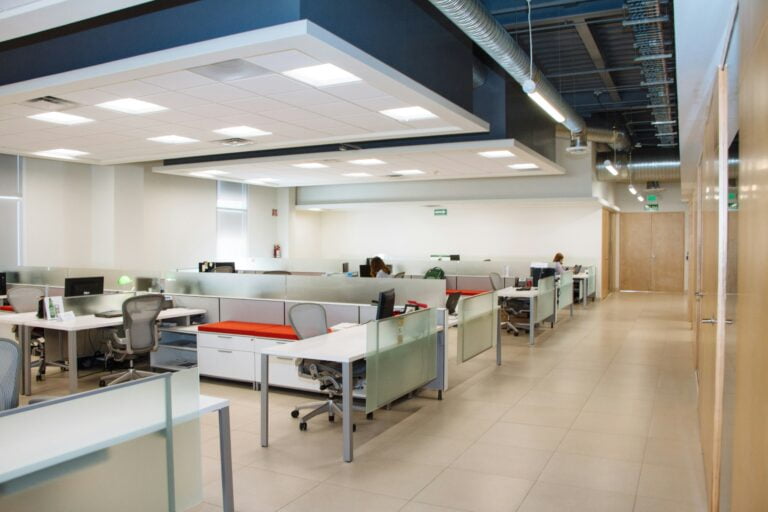
A BOHS report found that 68% of workers in open-plan offices report air quality-related symptoms such as headaches and eye irritation, compared with 42% in cellular offices.
Absenteeism is the most direct cost.
Respiratory illness, allergy flare-ups, and the general malaise associated with poor ventilation all translate into lost working days. Reduced cognitive performance is harder to measure but no less real.
A workforce operating in CO₂-saturated air is not performing at full capacity, even if nobody has formally raised a complaint.
Staff retention is increasingly relevant too.
Employees are paying closer attention to the environments their employers provide. An office that takes air quality seriously sends a clear signal about how much the organisation values its people.
What the Law Requires
Employers have clear legal duties in this area.
The Health and Safety at Work Act 1974 places a general duty on employers to protect the health of employees and others on their premises. The Workplace (Health, Safety and Welfare) Regulations 1992 require that enclosed workplaces are ventilated with a sufficient quantity of fresh or purified air.
The Control of Substances Hazardous to Health (COSHH) Regulations 2002 cover chemical contaminants in the workplace, including cleaning agents and VOCs.
On ventilation, Building Regulations Part F sets a minimum fresh air supply rate of 10 litres per second per person in office environments.
CIBSE TM40, the primary guidance document for building services engineers, recommends maintaining occupied workspace CO₂ levels below 800 ppm as a practical measure of ventilation performance. The HSE states that fresh air supply should not normally fall below 5 to 8 litres per second per occupant as an absolute minimum.

Practical Steps to Improve Office Air Quality
Tackle pollution at source
The most effective intervention is to reduce what is polluting the air in the first place, rather than trying to filter it out after the fact.
When specifying or replacing office furniture, carpets, and finishes, choose products certified to low-emission standards.
In Europe, E1-grade panels restrict formaldehyde emissions to a defined safe threshold. GREENGUARD Gold certification indicates that a product meets rigorous standards for chemical emissions. Low-VOC paints are now widely available and comparable in cost to standard products.
Older pressed-wood furniture continues to off-gas VOCs for years. Where budget allows, replacing it is a more effective long-term solution than air filtration. At the very minimum, ensure older furniture is in well-ventilated areas rather than enclosed meeting rooms or hot-desk clusters.
Ventilate properly and consistently
Opening windows and doors remains one of the most effective and cost-free ways to improve air quality.
It sounds obvious, but in climate-controlled buildings it is frequently overlooked in favour of relying entirely on mechanical ventilation systems that may not be meeting fresh air targets.
CO₂ monitors give you an objective, real-time picture of how well your ventilation is working. If CO₂ levels are climbing above 800 ppm in occupied spaces, that is a clear signal to increase air exchange, whether by opening windows, adjusting HVAC settings, or reviewing occupant density.
Monitors are inexpensive, easy to install, and straightforward to interpret.
Where mechanical ventilation is in place, make sure it is configured to meet Building Regulations Part F requirements of 10 litres per second per person.
A system that was sized for a lower occupancy level, or that has not been serviced recently, may be delivering far less fresh air than assumed.
Maintain a rigorous cleaning schedule
Dust, debris, and biological matter do not stay where they settle.
Every time someone walks across a carpet, pulls open a drawer, or switches on a fan, particulates become airborne and enter the breathing zone.
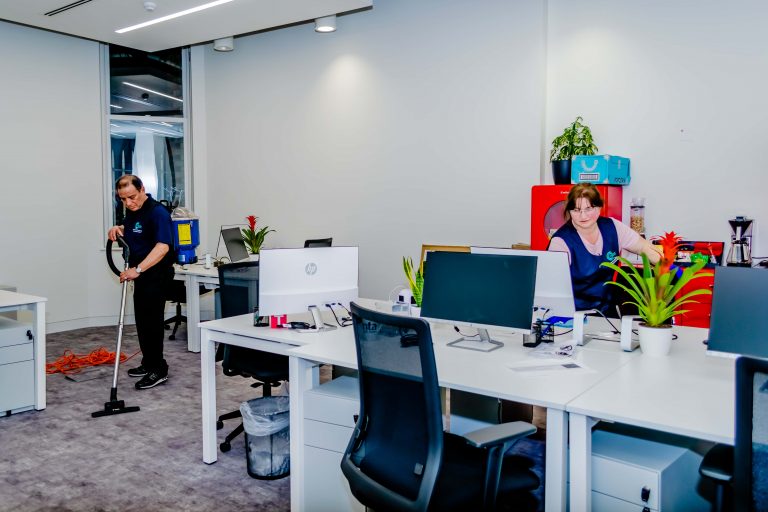
A professional cleaning programme that operates to a consistent schedule removes this build-up at source, rather than waiting for it to circulate.
At Alliance Cleaning, our contract managers look after fewer sites than the industry average, which means more attention to the specific needs of each building, faster identification of problem areas, and a more responsive service when issues arise.
All of our operatives are trained through the Alliance Pathway programme, and our quality management processes are certified to ISO 9001. Clean buildings are healthier buildings, and a well-maintained cleaning schedule is one of the simplest things you can do for indoor air quality.
Keep your HVAC and air ducts in good order
Air handling systems redistribute whatever is in them throughout the building, every time they run.
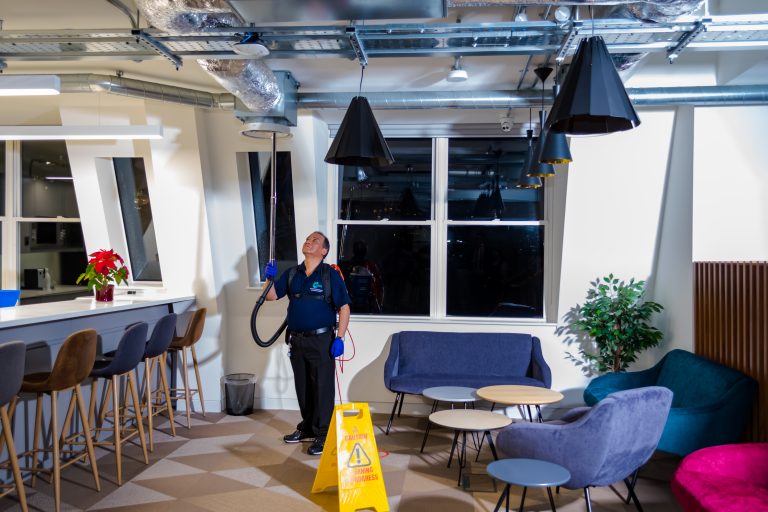
Dust, debris, and microbial build-up in ductwork become airborne pollutants the moment the system switches on. TR19-compliant ductwork cleaning removes this accumulation to a defined standard, and should be part of any planned maintenance programme.
Filter replacement is equally straightforward but frequently deferred.
Air filters lose effectiveness over time, and a clogged filter reduces airflow as well as filtration performance.
Replace filters according to manufacturer guidance, and consider upgrading to HEPA filtration where budget allows. HEPA filters capture 99.97% of particles down to 0.3 microns, including the fine particulates most associated with respiratory irritation.
Use air purifiers to supplement ventilation
Portable air purifiers are a practical tool in spaces where ventilation is limited or where pollution sources are concentrated.
HEPA filters handle particulates, dust, allergens, and biological matter. Activated carbon filters are the appropriate choice where VOCs or chemical odours are a concern, as they are the only filter type that addresses gaseous pollutants.
The important framing here is that air purifiers work alongside good ventilation, not instead of it.
A purifier running in a poorly ventilated room with high CO₂ will filter some particulates but will not address the CO₂ problem. Get the ventilation right first, then use purifiers where they add genuine value.
Bring nature into the workspace
Plants will not measurably clean the air at any practical office density. The research on that point is clear.
The case for bringing plants into the workplace, however, rests on solid ground for other reasons entirely.
University of Exeter research found that employees in offices with plants report higher levels of concentration and job satisfaction.
In dry, climate-controlled environments, plants contribute to humidity regulation through transpiration. During winter, when heating systems strip moisture from the air, this helps reduce the eye irritation and dry throats that many office workers experience.
In open-plan settings, larger plants and dense foliage absorb sound and contribute to acoustic comfort. Studies consistently show that access to greenery reduces self-reported stress in workplace settings.
Healthy plants also signal care.
A well-tended office with thoughtful planting communicates something to both staff and visitors about how seriously the environment is taken. That is a sound reason to have them.
How Do You Know If It Is Working?
CO₂ monitoring is the most practical and affordable way to assess ventilation performance in real time.
A monitor placed in an occupied space tells you whether your ventilation system is actually delivering adequate fresh air, not just whether it is switched on. If CO₂ stays below 800 ppm throughout the working day, your ventilation is doing its job.
If it climbs above that, especially in meeting rooms (frequently the worst-performing spaces in any building), you have an actionable data point rather than a vague sense that something is wrong.
Broader air quality monitors can also measure particulates, humidity, VOC levels, and temperature. These are useful in spaces where occupant complaints suggest a specific issue, or where a recent refurbishment has introduced new materials.
In Summary
Indoor air quality rarely features on a facilities manager’s priority list until something goes wrong.
By then, the effects on staff health, attendance, and performance are already playing out. The good news is that the most impactful steps are also the most straightforward: address pollution at source, ventilate consistently, and keep the building genuinely clean.
Air purifiers and CO₂ monitors add precision where it is needed. Plants, used for the right reasons, contribute to a healthier and more pleasant working environment.
None of this requires a significant capital outlay.
What it requires is a consistent approach, the right professional support, and a clear understanding of what the law expects. An office that gets these basics right is one where people feel better, work better, and stay longer.
Get in Touch
If you would like to talk through how a professional cleaning programme can support the air quality and health of your workplace, our team is ready to help.
Contracted clients benefit from a one-hour response time on first contact, and every client is supported by a dedicated contract manager who knows your site inside out.
Call us on 01992 700073 or email [email protected] for a free, no-obligation quote.
Frequently Asked Questions
What is a healthy CO₂ level for an office?
CIBSE guidance recommends keeping occupied workspaces below 800 parts per million (ppm). Above that threshold, a space is considered inadequately ventilated. Above 1,000 ppm, research shows cognitive performance begins to decline, with effects on concentration, decision-making, and response time.
What causes poor indoor air quality in offices?
The main causes are CO₂ build-up from occupancy, VOCs off-gassing from furniture, carpets, and paints, dust and particulate accumulation, biological matter in poorly maintained air handling systems, and inadequate fresh air ventilation. Most of these pollutants are invisible and odourless, which is why symptoms often appear before the source is identified.
Are employers legally required to maintain good air quality in offices?
Yes. The Health and Safety at Work Act 1974 places a general duty on employers to protect employee health. The Workplace (Health, Safety and Welfare) Regulations 1992 require adequate ventilation in enclosed workplaces. Building Regulations Part F sets a minimum fresh air supply of 10 litres per second per person in office environments.
Do HEPA air purifiers actually work?
HEPA filters are highly effective at capturing particulates, including dust, allergens, and biological matter down to 0.3 microns. They will not remove gases or VOCs; for those, activated carbon filters are required. Air purifiers work best as a supplement to good ventilation, not as a replacement for it.
Can office plants improve air quality?
Plants bring genuine benefits to office environments, including improved staff wellbeing, stress reduction, humidity regulation, and acoustic comfort. They do not clean the air at any practical office density. The volume of plants required to meaningfully reduce VOC levels or CO₂ is not achievable in a normal working environment. The case for plants is strong, just on different grounds.
What are VOCs and why do they matter in offices?
VOCs (volatile organic compounds) are gases emitted by many common materials including pressed-wood furniture, carpets, adhesives, paints, and cleaning products. Formaldehyde is among the most prevalent. At elevated concentrations they can cause eye, nose, and throat irritation, headaches, and longer-term health effects. The most effective way to address them is to specify low-emission materials and ensure adequate ventilation.
How do I know if my office ventilation is adequate?
A CO₂ monitor is the simplest tool available. If CO₂ levels remain below 800 ppm throughout the working day, your ventilation is performing adequately. If levels climb above that, especially in meeting rooms and high-occupancy areas, you need to increase fresh air supply, either by opening windows, adjusting HVAC settings, or reviewing occupant density.
What cleaning practices most improve indoor air quality?
Regular vacuuming with HEPA-filtered equipment, consistent surface cleaning to prevent dust accumulation, and scheduled maintenance of air handling systems all contribute to better air quality. Professional cleaning programmes are more effective than ad hoc approaches because they operate to a defined schedule and standard, removing particulate build-up before it becomes airborne.
How does professional cleaning support indoor air quality?
Professional cleaning removes dust, debris, and biological matter from surfaces, carpets, and air handling systems before it becomes airborne. A consistent cleaning schedule prevents the gradual build-up that causes air quality to deteriorate over time. Professionally trained operatives also use appropriate products and methods that do not introduce additional chemical pollutants into the workspace.